Introduction: The $10 Lesson That Changed My SEO Journey
Hey everyone, I’m Pivo, and if you’re diving headfirst into digital marketing, trying to build your first profitable website, you’re likely buzzing with excitement. I was exactly there a few months ago. I had a fantastic niche idea and found what I thought was the perfect domain name. It was available with a .cc extension and—crucially—it was dirt cheap for the first year. I registered it immediately, feeling like a genius who had scored a deal.
Then came the cold splash of reality. After getting my logo designed and starting the site framework, I discovered the exact same name with the .com extension belonged to an established, trademarked competitor. My heart sank. That $10 initial excitement turned into a massive setback. The financial cost was minimal, but the lost time and mental exhaustion of a forced complete rebrand were devastating.
This article is my painful $10 lesson made public. I’ve distilled my regret into the 8 crucial domain name mistakes you must avoid, ensuring your foundational domain choice is an asset, not an anchor.
Costly Mistake #1: The Trademark Time Bomb (The Most Fatal Error)
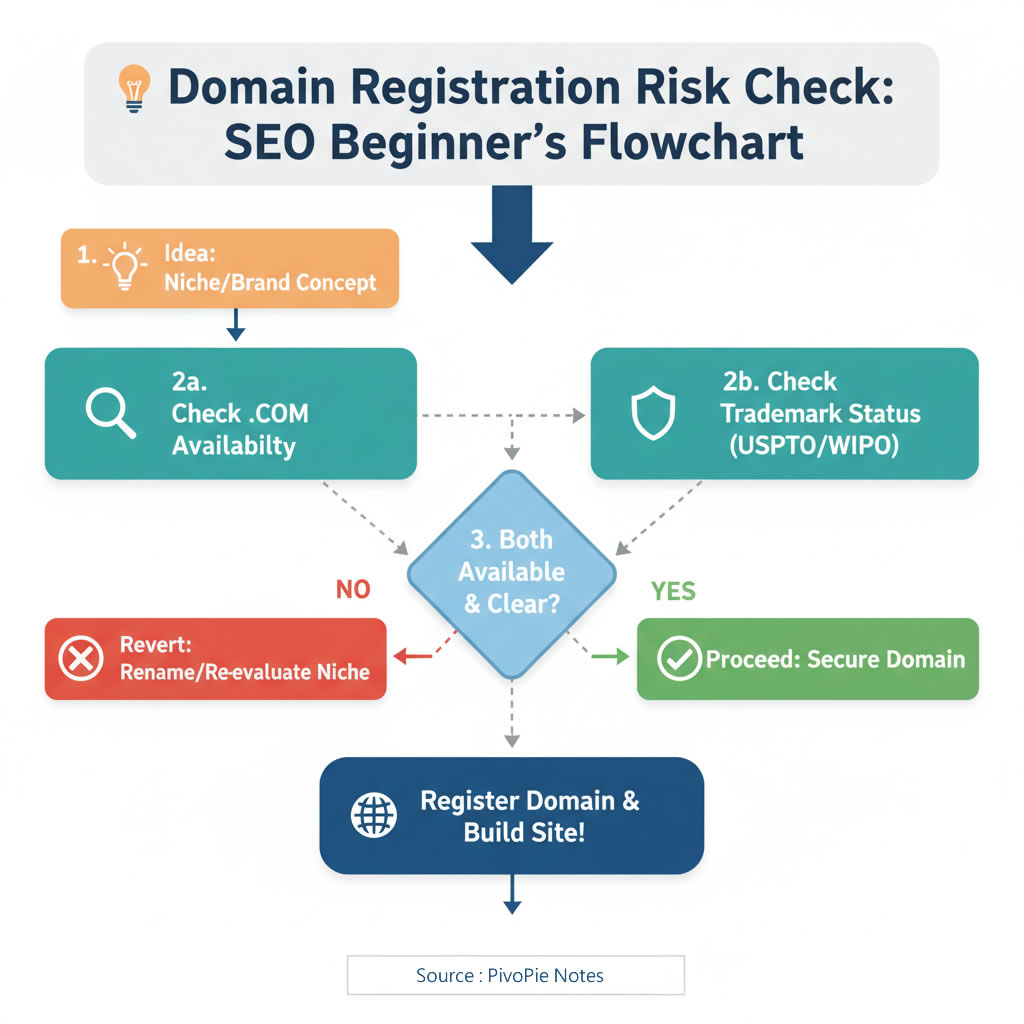
My biggest blunder was letting price override due diligence. When you buy a domain, you are staking a claim on a brand name. If a strong, established business already owns the .com version or has a trademark on the name, you are walking into major legal and SEO headwinds.
The Double Consequence of Brand Conflict
- The Legal Risk: Trademark holders have the right to challenge and potentially seize domains that cause consumer confusion. This can tank your project before you even publish your first piece of content.
- The Authority Drain: Even without a lawsuit, if the .com is a well-known entity, every user who defaults to that TLD is boosting your competitor’s traffic and authority, leaving you perpetually fighting for recognition.
💡Your Lesson:The legal fallout from making domain name mistakes related to trademarks will always cost more than the money you save on a cheap TLD. Never register a domain without a quick trademark search first. Before you register, always perform a thorough trademark search using official databases like the U.S. Patent and Trademark Office (USPTO) to avoid legal headaches.
Costly Mistake #2: The TLD Trust Trap: Why You Must Default to .COM
Among the most common domain name mistakes made by beginners is the assumption that any TLD (Top-Level Domain) is as good as .COM. As a beginner, you’ll hear advice pushing trendy TLDs like .co, .io, or .xyz. But for your first broad-audience site, the unvarnished truth is: stick to .com.
Most users assume a legitimate, professional business lives at a .com address. Choosing a different TLD when the .com is a competitor introduces unnecessary cognitive load and trust friction for your audience.
| TLD (Top-Level Domain) | Pros for Beginners | Cons for Beginners |
|---|---|---|
| .com | Universal Trust Signal, highest recall rate, and instantly projects professionalism and authority. | Often demands more creative naming strategies; can have a higher long-term renewal cost. |
| .net / .org | Acceptable fallbacks if securing the perfect .com is truly impossible. | Often perceived as secondary or non-authoritative; increases the risk of brand confusion if the .com is a major competitor. |
| .co / .io / .xyz | Trendy, excellent for niche tech startups (.io) or providing shorter, snappier names (.co). | Lowers public trust initially; readers often forget the extension and default to .com, diverting your potential traffic. |
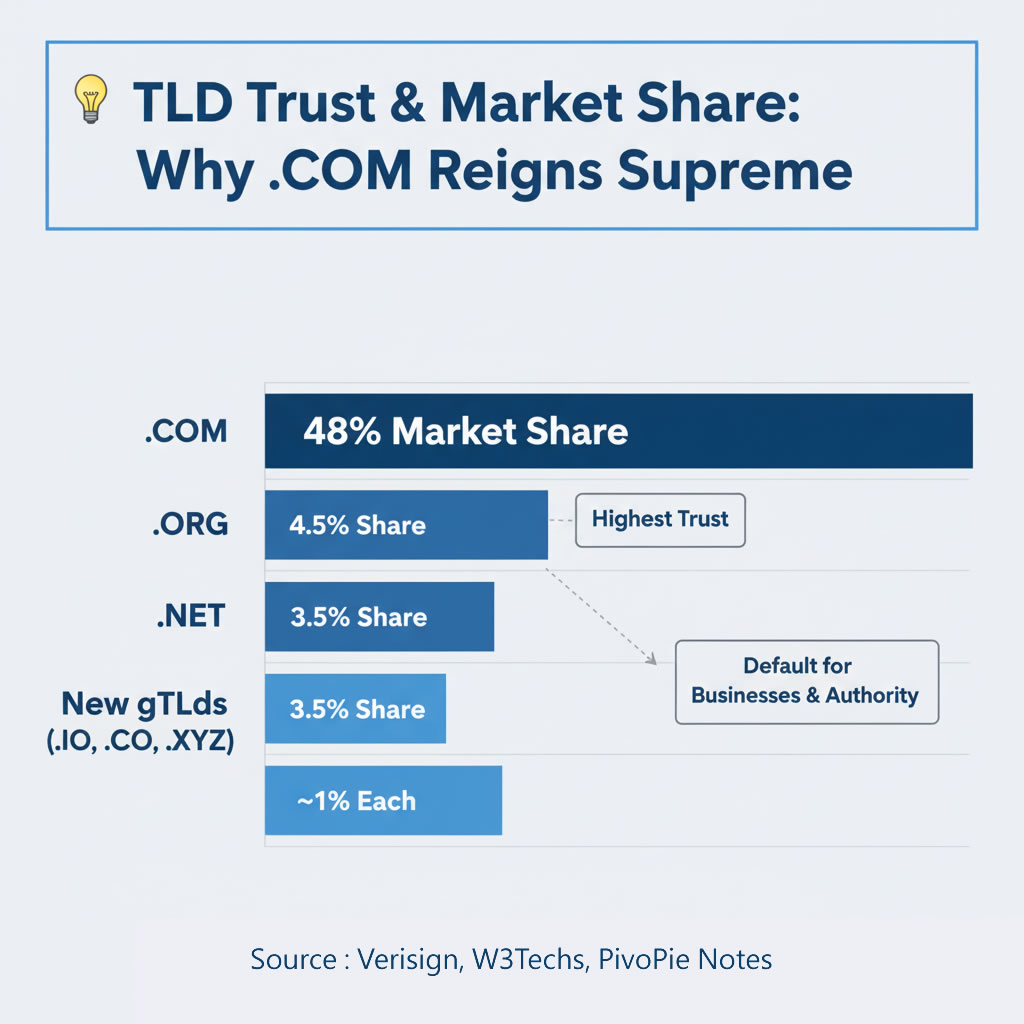
The dominance of .COM is not just perception; data from industry leaders like Verisign consistently shows its overwhelming market share.
The Modern Exception: When .AI Works
While the default rule is always .com, the exception lies in strategic niche alignment. If your blog is exclusively focused on a modern, highly specialized field like Artificial Intelligence, Machine Learning, or Data Science, a TLD like .AI can actually serve as a powerful Brand Signal. In this specific context, it may enhance professional trust and align your domain directly with your targeted expert audience. This is a strategic choice, not a budget one.
Costly Mistake #3: The Hidden Cost Killer: Ignoring the 300% Renewal Hike
My $10 domain was a classic bait-and-switch. Many registrars offer dirt-cheap first-year deals ($1.99 or $9.99) only to hike the price up 300% to $20 or $30 per year in year two.
💡Actionable Advice: Always check the long-term renewal pricing upfront; this is one of the most common and easily avoided domain name mistakes that sinks budgets. If the renewal price is too high, start on a registrar that offers consistently lower long-term rates. Migrating a domain later is far more work than just choosing the right registrar now.
Costly Mistake #4: The Memorability Massacre: Hyphens, Numbers, and Obscure Spellings
Your domain must be easy to say on a podcast, tell a friend over the phone, and type quickly. SEO value aside, word-of-mouth marketing is your biggest friend.
- Avoid Hyphens: They confuse people and make your domain look spammy.
- Avoid Numbers: They create ambiguity (Is it the numeral 4 or the word four?).
- Keep it Short and Simple: If you have to tell someone, “It’s spelled with a ‘K’ instead of a ‘C’ and a dash in the middle,” you’ve already lost.
Costly Mistake #5: The Brand Mismatch: Failing the Social Media Check
A consistent brand is a powerful brand. Before you commit, make sure the corresponding handle (or something very close) is available on major platforms like X (Twitter), Instagram, and TikTok.
If your domain is BestPestControl.com but your Instagram handle has to be @TheBestPestControlGuy_99, you are confusing your audience and diluting your brand identity. Check social availability before registration.
Costly Mistake #6: The Embarrassment Test: Failure to Read Aloud
Read your domain out loud, rapidly, and combine all the words. Domains that seem clever on paper can unintentionally spell out awkward, embarrassing, or even offensive phrases when stripped of spacing (e.g., ExpertsExchange). Run the “read it fast” test!
Costly Mistake #7: The Regional Restriction: Global Goals with a Local TLD
If you are only targeting a specific country (e.g., a local business serving the UK), then using a regional TLD like .co.uk is entirely appropriate and can actually help your local SEO efforts.
However, if your plan is to eventually target a global, English-speaking market, stick with a generic TLD like .com. Choosing a country-specific TLD boxes you into a region with Google and limits your scaling potential from the start.
One powerful tool for advanced vetting is the Wayback Machine from the Internet Archive, which allows you to see how a domain looked years ago.
Costly Mistake #8: The Keyword Stuffing Trap: Sacrificing Brand for SEO
As a beginner, it’s tempting to cram your main keyword into your domain, like BestCheapDogFoodReviews.com. While keywords can help slightly, Google is far more sophisticated now.
A short, memorable, and brandable name (like DogFoodie.com or ThePoochPatrol.com) is infinitely more valuable long-term. It builds trust, encourages direct visits, and is easier to link to.
💡Your Lesson: Prioritize brandability and memorability over stuffing keywords. A strong brand is good SEO.
Conclusion: Your Ultimate Domain Due Diligence Checklist
Choosing the right domain is foundational—don’t let an inexpensive initial fee lure you into a long-term problem. You’ve learned from my regret: check the trademark, prioritize the .com, and think long-term about your costs and branding.
By following the steps in this ultimate due diligence checklist, you can confidently avoid these domain name mistakes and ensure your site has the strong foundation it deserves.Here is the non-negotiable checklist I use now to vet every domain:
- Trademark Check: Confirmed no established .com competitor or trademark conflict exists.
- TLD Priority: The domain is available as a .com (or a strategic exception like .ai).
- Renewal Price Audit: The long-term annual renewal cost is acceptable.
- Clarity & Memorability: It is short, easy to say, easy to spell, and contains no hyphens or numbers.
- Social Consistency: The corresponding handle is available on major social platforms.
- The Read-Aloud Test: No hidden, embarrassing, or confusing word combinations.
- Target Audience Check: The TLD matches the geographical reach (Global = .com).
- Brand Over Keywords: The name is memorable and brandable, not just a string of keywords.
Frequently Asked Questions (FAQs)
What should I do if I already bought a domain name that violates a trademark or is hard to rank?
Don’t panic, but stop investing time and money immediately. The financial cost of an unusable domain is far less than the cost of a forced rebrand later. Your best move is to treat it as a sunk cost, let the registration expire, and focus your energy on securing a new, legally safe, and SEO-friendly domain name that aligns with your brand. Never build a site on a shaky foundation.
Should I try to sell a domain name that I bought by mistake (e.g., selling it to the .com owner)?
For SEO beginners, selling mistyped or problematic domains is generally not recommended. Selling a domain that infringes on an existing trademark can expose you to legal risk. Even if there’s no legal issue, domain resale is a complex, predatory market (Domain Flipping) that distracts you from your main goal: building content. Unless you’re a professional domain investor, cut your losses and focus on content creation.
Is it worth buying premium domain names that cost over $1,000?
For a beginner launching their first SEO content site, absolutely not. Premium domains are often short, highly brandable, but offer zero SEO advantage over a standard registered domain. That $1,000 is better spent on essential tools (like hosting or a keyword research subscription) and high-quality content creation. Focus on creating an authoritative brand first, not buying an expensive name.
Does Google penalize a domain name if it is too long or contains a hyphen?
Google doesn’t apply a direct ‘penalty’ simply for length or hyphens, but it does affect SEO indirectly. Long domains are harder to remember and share (lower recall rate). Hyphens were historically abused for keyword stuffing, so they can sometimes signal lower quality, though Google has denied a direct penalty. Our lesson: keep it short, hyphen-free, and brandable to maximize user trust and recall (your human visitors).
Ready to unlock the full blueprint for launching your first profitable SEO site? Don’t miss out!
Subscribe to my email list today and get the Domain Registration Detailed Inspection Report PDF.
This isn’t just the checklist above—it’s the comprehensive 20-page guide I use now, including:
- The 4 Critical Registrar Evaluation Standards: Learn how to choose a provider based on long-term cost transparency, privacy features, and transfer policies.
- The 5 Costly Red Flags to Avoid: Discover the hidden tactics and pricing structures that lead to expensive domain lock-in and mandatory rebranding.
- The Brand Brainstorming Worksheet: A hands-on tool to vet social handles and develop SEO-friendly, brandable domain names.
- Advanced Vetting Tools: My proprietary method for checking a domain’s hidden historical baggage (and avoiding Google penalties).
Ensure you never fall into the costly traps I did!